 一孔录
子曰:君子之于天下也,无适也,无莫也,义之与比。The Master said: The gentleman, in dealing with the world, has no fixed yes and no fixed no; he sides with what is right.
Tap any sentence of the original to copy it with its source.
白Plain Chinese
孔子说:君子对于天下的事情,没有规定一定要怎样做,也没有规定一定不要怎样做,只要合理恰当,就照着去做。
A plain modern-Chinese rendering following Yikonglu's reading.
常The common reading
Is this “no principles, just see how it goes”?
注Key words in the commentary
di (适) read di, bi (比) read bi; Zhu Xi: “适,专主也。《春秋传》曰‘吾谁适从’是也。莫,不肯也。比,从也” — di means to insist on one thing in advance, as in the Spring and Autumn commentary “whom shall I follow?”; mo means to refuse; bi means to follow.
家What other commentators say
Zhu Xi also records Xie Liangzuo's other reading: “适,可也。莫,不可也。无可无不可,苟无道以主之,不几于猖狂自恣乎?圣人之学不然,于无可无不可之间,有义存焉” — di means “may,” mo means “may not”; with nothing either allowed or forbidden, if no Way governs it, is this not close to reckless self-indulgence? The sage's learning is otherwise: between “may” and “may not,” rightness is present. Both readings are given; the chapter closes on Xie's “rightness is present.”
读How Yikonglu reads it
Do not decide in advance and do not refuse in advance; look only at whether it accords with what is right. “Nothing allowed, nothing forbidden” without rightness in charge is mere recklessness. Today: a line judge does not decide beforehand who should win, but bends down to see whether this one ball touched the line.
家Other commentaries
Our base text is Zhu Xi's Collected Commentaries (above). Here are other commentaries side by side: for old commentaries, the first line of the sub-commentary with a link to the woodblock scan; for modern editions, one short quoted translation for comparison. The “compared with Zhu Xi” notes are written by Yikonglu, not quoted.
皇侃《论语义疏》Liang dynasty · Zhibuzu Zhai edition · juan 二
“范甯曰:適莫,猶厚薄也。”……
Compared with Zhu Xi
| Commentary | Point | Relation | Confidence | Note |
|---|---|---|---|---|
| 杨伯峻《论语译注》 | same | settled | 杨明确采用朱注,以适为必、莫为不可,唯义是从;并非对所有事情无判断。 | |
| 钱穆《论语新解》 | same | fairly sure | 同主取适为专主、莫为不肯、比为从,以义裁断而无固定可否。钱并存适敌莫慕的另一说而未作主取。 |
核Check every citation
Every commentary line quoted in the video: the original wording, who said it, and the page in the base edition. “Paraphrase” marks our summary, not the commentator's words. About this edition
| Quoted text | Source | Page |
|---|---|---|
| “适,专主也。春秋传曰:吾谁适从,是也。莫,不肯也。比,从也” | Zhu Xi's commentary | page 55 |
| “适,可也。莫,不可也。无可无不可,苟无道以主之,不几于猖狂自恣乎?……圣人之学不然,于无可无不可之间,有义存焉” | Xie Liangzuo, quoted by Zhu Xi | page 55 |
音Pronunciation
| Character | In the line | Read as |
|---|---|---|
| 适 | 无适也、吾谁适从、适可也 | dí |
| 莫 | 无莫也 | mò |
| 比 | 义之与比、比从也 | bì |
页Pages of the base edition
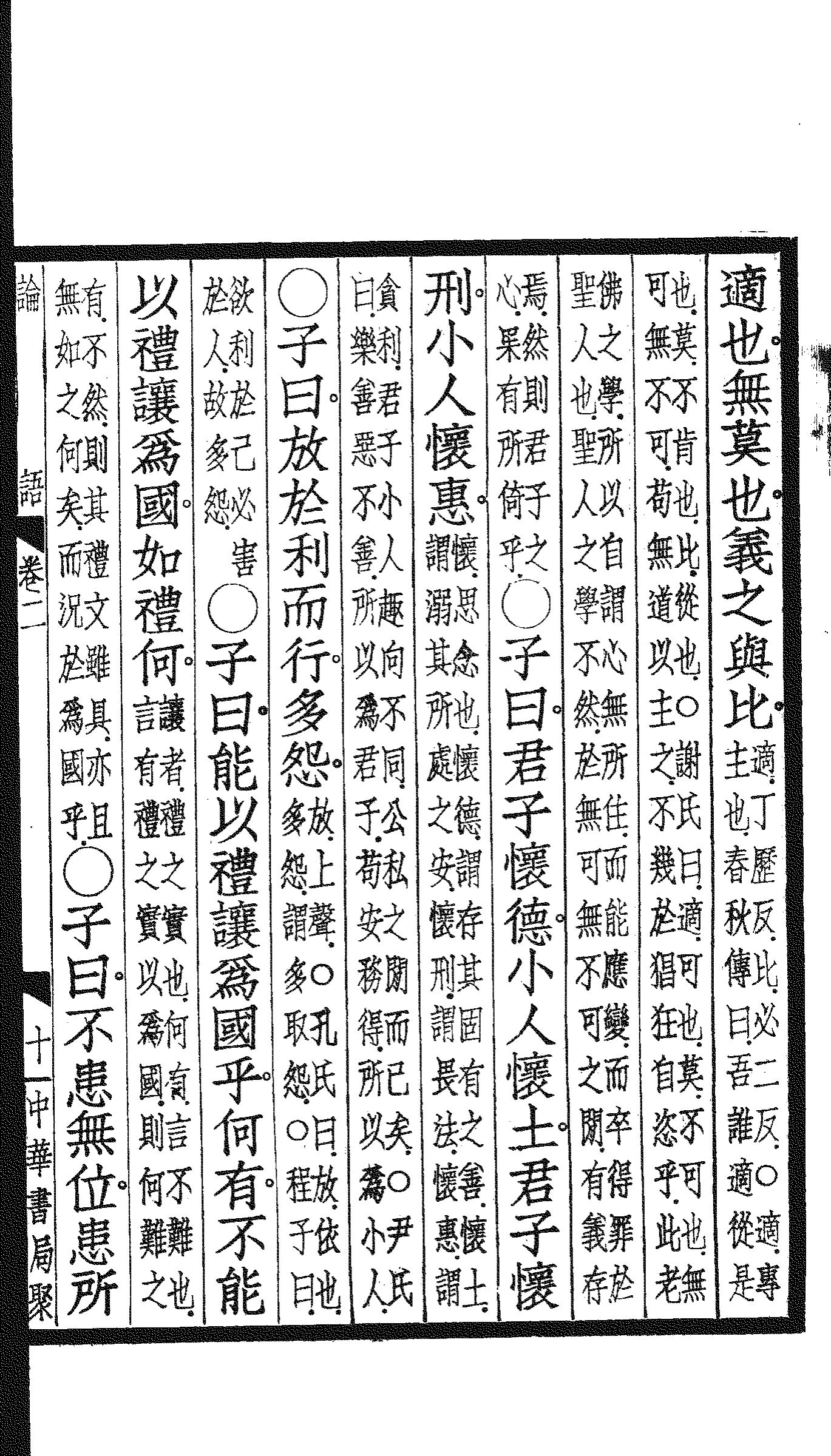
Yikonglu, Analects Li ren (Book 4) 4.10 “No fixed yes, no fixed no; side with what is right”, https://yikonglu.com/en/lunyu/li-ren/10.html, version 2026-11-04.Last checked: 2026-11-04. Changes are logged on theerrata page.
Found an error in this chapter? Email us; once checked, it goes on the errata page under your username: 
