 一孔录
子曰:朝闻道,夕死可矣。The Master said: If one hears the Way in the morning, one may die at dusk without regret.
Tap any sentence of the original to copy it with its source.
白Plain Chinese
孔子说:早晨得知了真理,就是当天晚上死去,也没有遗憾了。
A plain modern-Chinese rendering following Yikonglu's reading.
常The common reading
Is this a heroic line about not fearing death, about dying for the truth?
注Key words in the commentary
zhao (morning) read zhao; “道者,事物当然之理。苟得闻之,则生顺死安,无复遗恨矣。朝夕,所以甚言其时之近” — the Way is the principle by which things ought to be; once one has truly heard it, one lives in accord and dies at peace, with nothing left to regret; “morning” and “dusk” stress how short the gap may be.
家What other commentators say
Cheng Yi: “言人不可以不知道,苟得闻道,虽死可也” — a person cannot do without knowing the Way; having heard it, even death is acceptable. Cheng Hao: “皆实理也,人知而信者为难。死生亦大矣!非诚有所得,岂以夕死为可乎” — these are all real principles; knowing them is easy, truly believing them is hard; life and death are a great matter — unless one has truly gained something, how could one call dying at dusk acceptable?
读How Yikonglu reads it
The hard part is not hearing, but still believing after one has heard. Life and death are the great matter; without something truly gained in the heart, no one can say “I may die at dusk.” Today: an old man in a hospital bed finally sees through what he never understood in a lifetime, takes his daughter's hand and says, “Now I am at peace.”
家Other commentaries
Our base text is Zhu Xi's Collected Commentaries (above). Here are other commentaries side by side: for old commentaries, the first line of the sub-commentary with a link to the woodblock scan; for modern editions, one short quoted translation for comparison. The “compared with Zhu Xi” notes are written by Yikonglu, not quoted.
皇侃《论语义疏》Liang dynasty · Zhibuzu Zhai edition · juan 二
“歎世無道,故言設使朝聞世有道,則夕死無恨,故云可矣。”……
Compared with Zhu Xi
| Commentary | Point | Relation | Confidence | Note |
|---|---|---|---|---|
| 杨伯峻《论语译注》 | same | fairly sure | 闻道比存生更重要;朱说明死亦无憾、非教人闻道即求死,杨译未增求死之义。 | |
| 钱穆《论语新解》 | same | fairly sure | 同以闻道则死而无憾,朝夕极言时近。钱强调人生大道与急求不枉此生,朱训道为事物当然之理、生顺死安。 |
核Check every citation
Every commentary line quoted in the video: the original wording, who said it, and the page in the base edition. “Paraphrase” marks our summary, not the commentator's words. About this edition
| Quoted text | Source | Page |
|---|---|---|
| “道者,事物当然之理。苟得闻之,则生顺死安,无复遗恨矣。朝夕,所以甚言其时之近” | Zhu Xi's commentary | page 54 |
| “言人不可以不知道,苟得闻道,虽死可也……皆实理也,人知而信者为难。死生亦大矣!非诚有所得,岂以夕死为可乎” | Cheng Yi, quoted by Zhu Xi | page 54 |
音Pronunciation
| Character | In the line | Read as |
|---|---|---|
| 朝 | 朝闻道、朝夕 | zhāo |
页Pages of the base edition
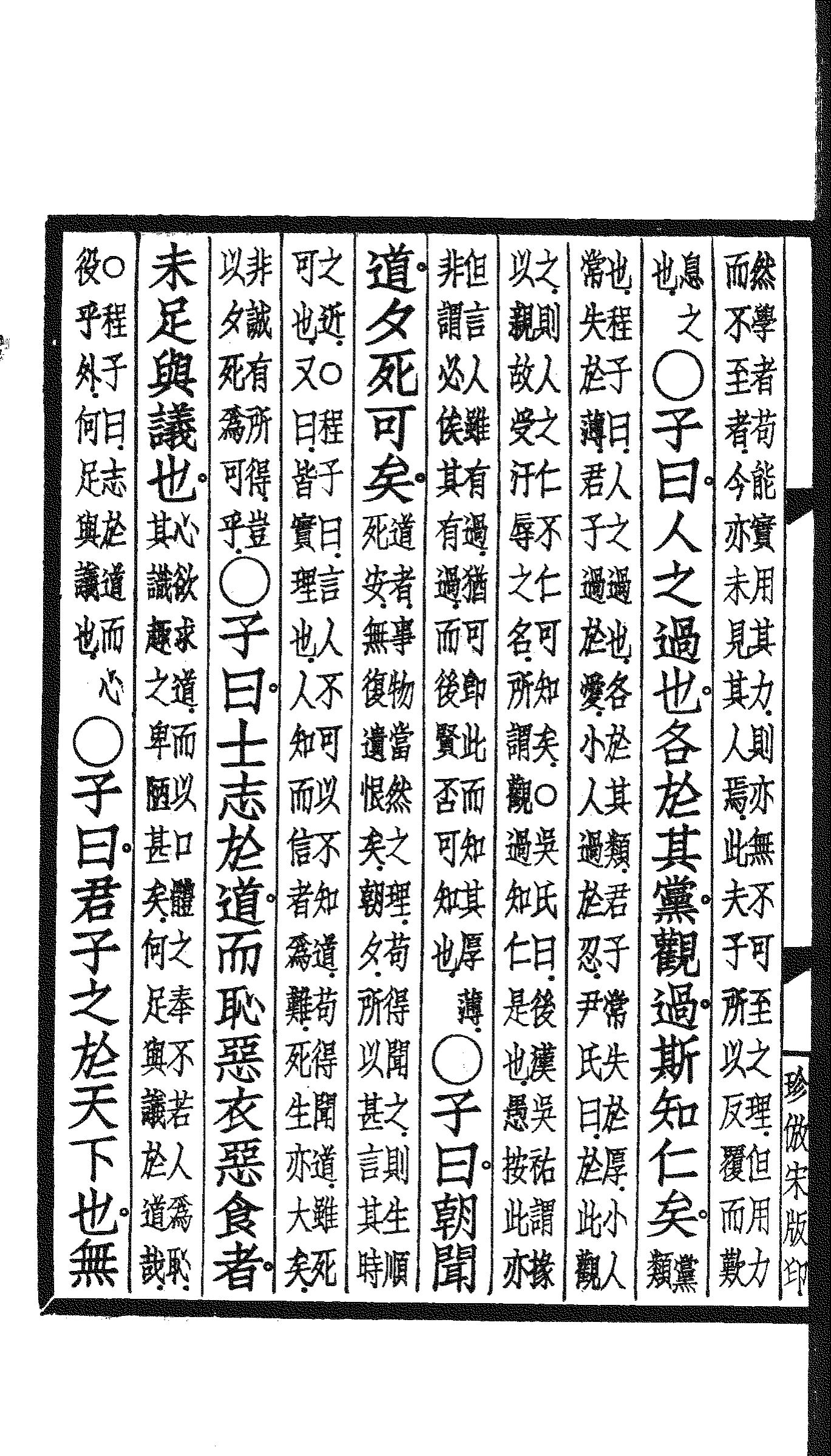
Yikonglu, Analects Li ren (Book 4) 4.8 “Hear the Way in the morning, die content at dusk”, https://yikonglu.com/en/lunyu/li-ren/8.html, version 2026-11-04.Last checked: 2026-11-04. Changes are logged on theerrata page.
Found an error in this chapter? Email us; once checked, it goes on the errata page under your username: 
