 一孔录
子曰:君子怀德,小人怀土;君子怀刑,小人怀惠。The Master said: The gentleman cherishes virtue, the petty man cherishes his own ground; the gentleman cherishes the law, the petty man cherishes favors.
Tap any sentence of the original to copy it with its source.
白Plain Chinese
孔子说:君子怀念的是道德,小人怀念的是乡土;君子关心的是法度,小人关心的是恩惠。
A plain modern-Chinese rendering following Yikonglu's reading.
常The common reading
Is “cherishing one's ground” just homesickness, and is the petty man simply a bad person?
注Key words in the commentary
“怀,思念也。怀德,谓存其固有之善。怀土,谓溺其所处之安。怀刑,谓畏法。怀惠,谓贪利” — huai means to keep in mind; cherishing virtue means preserving the good one already has; cherishing one's ground means being sunk in the comfort of where one is; cherishing the law means fearing the law; cherishing favors means craving gain; “君子小人趣向不同,公私之间而已矣” — gentleman and petty man differ in where they tend, and that is only the line between public and private.
家What other commentators say
Yin Tun: “乐善恶不善,所以为君子;苟安务得,所以为小人” — delighting in good and hating what is not good makes the gentleman; settling for ease and striving for gain makes the petty man.
读How Yikonglu reads it
“Cherishing one's ground” is not homesickness; it is a heart that guards only its own little comfort. The whole difference between gentleman and petty man lies between public and private. Today: two people receive the same job offer in another city; one asks first what he can learn and whom he can help, the other only which place is more comfortable to stay in.
家Other commentaries
Our base text is Zhu Xi's Collected Commentaries (above). Here are other commentaries side by side: for old commentaries, the first line of the sub-commentary with a link to the woodblock scan; for modern editions, one short quoted translation for comparison. The “compared with Zhu Xi” notes are written by Yikonglu, not quoted.
皇侃《论语义疏》Liang dynasty · Zhibuzu Zhai edition · juan 二
“云君子懷德者,懷,安也。”……
Compared with Zhu Xi
| Commentary | Point | Relation | Confidence | Note |
|---|---|---|---|---|
| 杨伯峻《论语译注》 | 刑 | word sense | settled | 杨取法度而非专指刑罚,与朱训法相合;土杨另记田土可通,朱取安居之地。 |
| 钱穆《论语新解》 | same | fairly sure | 同以品格与思念分君子小人,德对安土、畏法对求惠。钱明列乡土不忍去,朱把怀土着重于溺所处之安。 |
核Check every citation
Every commentary line quoted in the video: the original wording, who said it, and the page in the base edition. “Paraphrase” marks our summary, not the commentator's words. About this edition
| Quoted text | Source | Page |
|---|---|---|
| “怀,思念也。怀德,谓存其固有之善。怀土,谓溺其所处之安。怀刑,谓畏法。怀惠,谓贪利” | Zhu Xi's commentary | page 55 |
| “君子小人趣向不同,公私之间而已矣……乐善恶不善,所以为君子;苟安务得,所以为小人” | 朱注;朱注引尹氏 | page 55 |
页Pages of the base edition
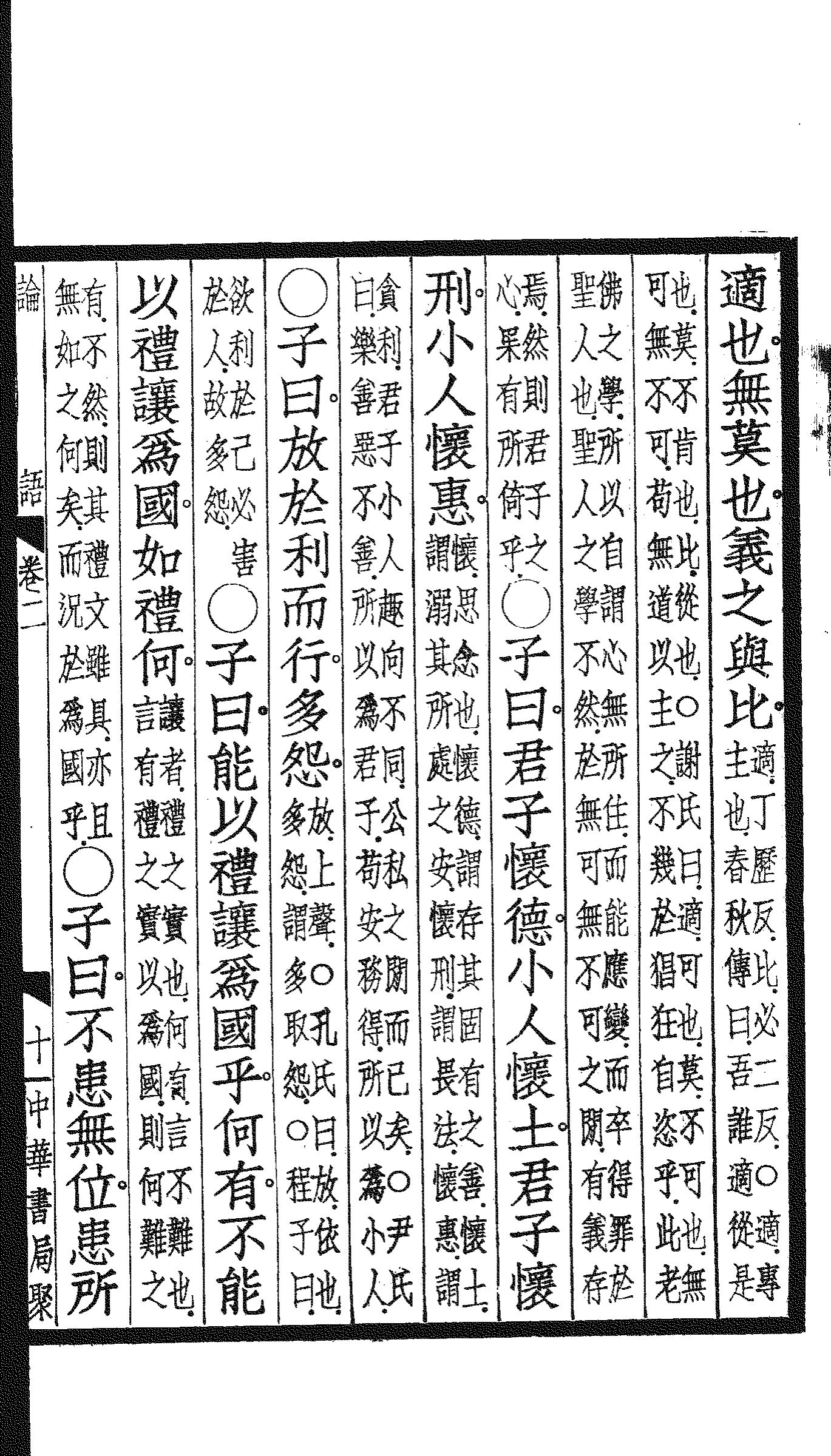
Yikonglu, Analects Li ren (Book 4) 4.11 “The gentleman cherishes virtue, the petty man his comfort”, https://yikonglu.com/en/lunyu/li-ren/11.html, version 2026-11-04.Last checked: 2026-11-04. Changes are logged on theerrata page.
Found an error in this chapter? Email us; once checked, it goes on the errata page under your username: 
